ΣΥΝΑΥΛΙΑ
Overview
| Event | Venue | Date | Entry |
|---|---|---|---|
| Μάγδα Βαρούχα & Χρήστος Αδαμόπουλος | Τεχνόπολη | Friday 5 June | €13 |
| 'Ερωτά μου αγιάτρευτε | ΚΠΙΣΝ | Sunday 7 June | Ticket |
| ΔΗΜΗΤΡΗΣ ΜΥΣΤΑΚΙΔΗΣ - Τριάντα Χρόνια Μήτσος | Τεχνόπολη | Wednesday 10 June | €15 |
| Δημήτρης Μυστακίδης | Τεχνόπολη | Wednesday 10 June | Ticket |
| Πάνος Βλάχος | Τεχνόπολη | Monday 29 June | €15 |
| Γιάννης Παπαγεωργίου | Καταφύ | Sunday 21 February | €12 |
| Ελένη & Σουζάνα Βουγιουκλή | Theatre Of The No | Saturday 13 March | €15 |
| Nίκος Ξυδάκης | Half Note Jazz Club | Saturday 24 April | €15 |
| Παύλος Καρποδίνης | Γυάλινο Μουσικό Θέατρο | Sunday 25 April | Ticket |
| Βασιλική Μιχαλοπούλου | Σταυρός του Νότου | Sunday 25 April | €15 |
| Χειμερινοί Κολυμβητές & Αλέξανδρος Κτιστάκης | Κύτταρο | Sunday 25 April | €20 |
| Κατερίνα Λαζαρίδου | Καφεθέατρο | Monday 26 April | Ticket |
| Δαυίδ Ναχμίας | Παρνασσός | Monday 26 April | Ticket |
Friday 5 June
Sunday 7 June
 ΣΥΝΑΥΛΙΑ
Wednesday 10 June
 ΣΥΝΑΥΛΙΑ
ΣΥΝΑΥΛΙΑ
Monday 29 June
 ΣΥΝΑΥΛΙΑ
Sunday 21 February
ΣΥΝΑΥΛΙΑ
Saturday 13 March
ΣΥΝΑΥΛΙΑ
Saturday 24 April
ΣΥΝΑΥΛΙΑ
Sunday 25 April
ΣΥΝΑΥΛΙΑ
ΣΥΝΑΥΛΙΑ
ΣΥΝΑΥΛΙΑ
Monday 26 April
ΣΥΝΑΥΛΙΑ
ΣΥΝΑΥΛΙΑ
In Detail
Μάγδα Βαρούχα & Χρήστος Αδαμόπουλος
What began as a spontaneous meeting between singer Magda Varouha and musician Christos Adamopoulos grew into *Akomplex-Arista*, one of the more talked-about live shows on the Greek circuit. On 5 June it reaches Technopolis in Gazi for the first time. The two trade a program of Greek song with no fixed lane — their own material, unexpected covers, and swapped roles between voice and instrument.
'Ερωτά μου αγιάτρευτε
Eighty people who lived through the 1980s the first time take the stage at the Stavros Niarchos Foundation Cultural Center, singing the songs that were playing while their own histories happened. Erota mou Agiatrefte — "my incurable love" — borrows its title from a laiko song and builds an evening around how one generation balanced love and politics across a single loud, fast decade. The work is created and directed by Alexandros Efklidis, who shaped it with roughly eighty participants aged 65 and over drawn from one of the SNFCC's educational programs.
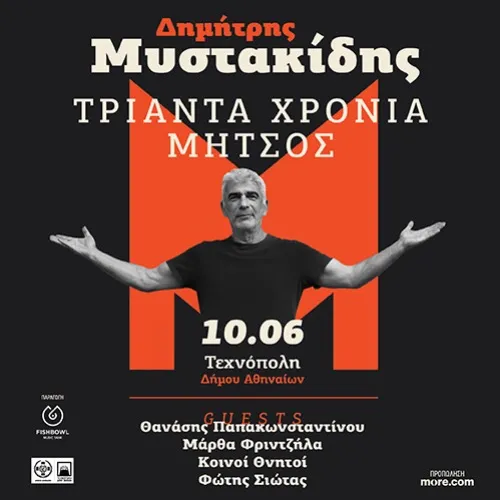
ΔΗΜΗΤΡΗΣ ΜΥΣΤΑΚΙΔΗΣ - Τριάντα Χρόνια Μήτσος
Thirty years on stage, and Dimitris Mystakidis marks them at Technopolis with the people who got him there. June 10 brings Thanasis Papakonstantinou, Martha Fritzila, and Fotis Siotas as guests, plus Michalis Atsalis on guitars and bouzouki, Giorgos Makris on gaida and kaval.
Δημήτρης Μυστακίδης
Dimitris Mystakidis marks thirty years onstage with '30 Chronia Mitsos' at Technopolis in Gazi — a guitarist whose name has become shorthand for rebetiko and laiko played on six strings rather than bouzouki. He is among the music's most committed champions today, and has said it became his first language. For the anniversary he gathers a stage of guests — Thanasis Papakonstantinou, Martha Frintzila, Koinoi Thnitoi and Fotis Siotas — names that trace the span of his collaborations.
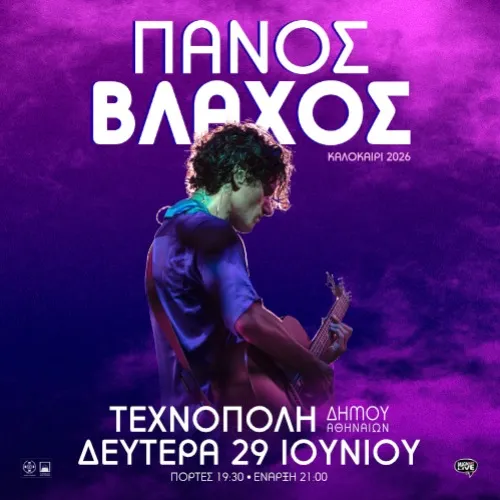
Πάνος Βλάχος
**Πάνος Βλάχος** returns to the **Τεχνόπολη** stage on Monday 29 June 2026 at 21:00 — the Greek actor-singer's second summer running at the Gazi cultural complex, this time anchored to his latest album «Πληγή Έμπνευσης» (*Wound of Inspiration*), with earlier songs and unreleased material woven through. A live band frames Vlachos's set: keyboards, electric guitar, winds, violin, bass, drums, and backing vocals, coordinated by Imaginart. Doors 19:30, set 21:00.
Γιάννης Παπαγεωργίου
Three instruments — electric guitar, acoustic guitar, lute — and one voice carry the Sunday-night set. Giannis Papageorgiou is a Greek songwriter working across fingerpicking, guitar effects, and loop playing; his solo format moves between his own catalogue ("Apo ti Siopi sti Siopi," "Skorpao," the recent "Lakouva" written for Giannis Dionysiou) and songs by Akis Panos, Manos Loizos, and Nikos Papazoglou. At Katafy the material strips to one performer — Papageorgiou's loop pedal carries arrangements where a backing band would normally sit. If you want a polished band, look elsewhere.
Ελένη & Σουζάνα Βουγιουκλή
The Vougioukli sisters return to Theatre of the No with "Roots & Rituals," the program they have brought to this venue before. Eleni and Souzana sing repertoire that crosses Southern Italian ecstatic song, Balkan polyphony, Greek folk material, and the spare end of blues and rebetiko. Theatre of the No holds about 100 people.
Nίκος Ξυδάκης
Nikos Xydakis takes the Half Note stage for two consecutive nights — 24 and 25 April 2027 — closing in on the Mets basement's seasonal shutter date, since Half Note runs October through May and then goes dark for summer. The Greek composer, whose catalogue spans collaborations with Eleftheria Arvanitaki and Sokratis Malamas, frames the residency as a transition from songs to set poems, from improvisations to small confessions.
Frequently Asked Questions
What is rebetiko and where can I hear it in Athens, Greece?
Rebetiko is an urban Greek musical tradition that emerged in port cities in the early 20th century — raw, blues-adjacent, built around bouzouki and songs of hardship, love, and displacement. UNESCO added it to the Intangible Cultural Heritage list in 2017. In Athens, Greece, Stoa Athanaton in the central market (Varvakios) hosts authentic weekly sessions. Klimataria in Monastiraki is another long-running venue. Sunday afternoon shows start around 13:00.
What's the difference between rebetiko, entechno, and laïko?
Rebetiko is the older urban tradition — raw and marginal in origin. Entechno (literally 'artistic music') developed in the 1960s through composers like Mikis Theodorakis and Manos Hadjidakis, fusing folk elements with classical structure and literary lyrics. Laïko ('popular music') is the mainstream commercial descendant — bigger stages, more bouzoukia, the soundtrack to celebrations. All three are alive in Athens and worth encountering on their own terms.
Where is the best place to hear live Greek music in Athens?
For rebetiko, Stoa Athanaton (inside the central meat market) is the institution — weekday lunches and weekend afternoons, open since 1930. For entechno and laïko, Stavros tou Notou in Neos Kosmos books the most respected Greek artists in an intimate setting. For the full bouzoukia experience — large venues, flowers thrown, later nights — look at venues along Poseidonos Avenue, though these lean more toward mainstream laïko.
Do I need to book in advance for rebetiko venues in Athens, Greece?
For established rebetiko venues like Stoa Athanaton, a reservation is strongly recommended — especially for Sunday afternoon sessions, which fill with locals. Call ahead or ask your accommodation to book. For smaller neighborhood venues and newer rebetiko nights, walk-ins are usually fine on weekdays. Weekends at popular spots fill by late evening regardless of reservation.